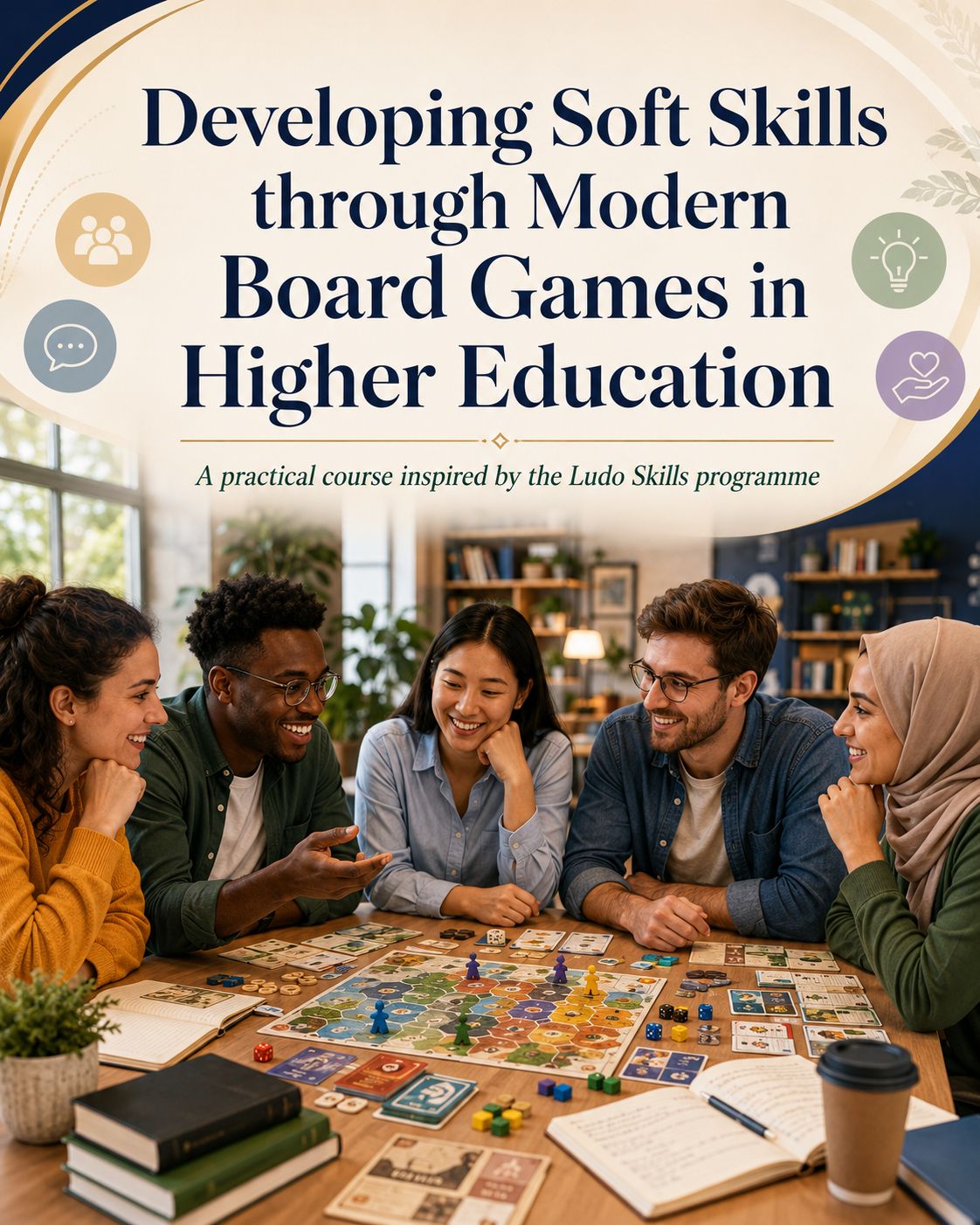
Modern board games can provide safe, structured environments in which behaviour, emotions and social interaction become visible. This hands-on course helps education professionals use board game-based learning to observe, understand and address behavioural and socio-emotional challenges such as impulsivity, emotional dysregulation, communication difficulties, peer conflict and screen-related risks. The emphasis is on observation, facilitation, debriefing and practical intervention design.
Who is it for?
Teachers, school counsellors, educational psychologists, support teachers, social educators, youth workers and other professionals interested in using modern board games to observe behaviour, support socio-emotional development and address group challenges in educational settings.
This course is especially suitable for professionals interested in using modern board games, game-based learning and active methodologies to observe, understand and address behavioural, social and emotional challenges in educational contexts.
What will you learn?
- Identify key behavioural and socio-emotional challenges in educational contexts.
- Use modern board games to observe behaviour, emotions, communication and group dynamics.
- Explore cooperative, communication-based and social deduction games to work on self-regulation, attention, empathy, teamwork and frustration tolerance.
- Facilitate structured debriefing to connect gameplay with real behavioural and social situations.
- Design a practical board game-based intervention proposal adapted to your own context.
How will you learn?
This is a hands-on, experiential course in which participants learn by playing, observing, reflecting and designing. Short theoretical inputs are combined with practical board game sessions, guided observation, group discussion and structured debriefing. Participants analyse what different games help to reveal and practise how to transfer these tools to real behavioural, social and emotional challenges. The course culminates in the design of a practical intervention case.
Course contents
- Behavioural and socio-emotional challenges: impulsivity, inhibitory control, emotional regulation, communication difficulties, peer conflict, bullying and screen-related risks.
- Board games as observation tools: identifying behaviours, emotions, social interaction, group dynamics and hidden needs.
- Games for self-regulation and social skills: cooperative, communication-based and social deduction games.
- Facilitation and guided observation: what to observe, how to intervene and how to manage group dynamics.
- Structured debriefing: connecting gameplay with reflection, behaviour and real-life situations.
- Intervention design: developing and presenting a practical board game-based proposal for an educational context.
Practical information
Duration: 20 hours
Participants: 8–20 participants
Language: English or Spanish
Dates & venue:
Dates and schedule are agreed with the organising institution. The course can be delivered in Valladolid, elsewhere in Spain, or internationally at your organisation.
Cost: Course fee tailored to duration, number of participants, location and specific training requirements.
Trainers
Azael J. Herrero is a university professor and researcher specialising in board game-based learning, gamification and educational innovation. He has more than 15 years of experience using modern board games in educational contexts and has extensive experience training educators in European and international projects. In this course, he contributes expertise in game selection, facilitation, group dynamics and educational intervention design.
Miriam Herrero-Martín is an Educational Psychologist and Psychopedagogue with professional experience in student support, wellbeing and educational guidance. She is currently completing a PhD at the University of Valladolid on the use of board games in Primary Education. Her contribution to this course focuses especially on behavioural challenges, emotional regulation, communication difficulties, bullying, social conflict and socio-emotional development.
Registration & contact
Interested in this course or need a tailored version for your organisation?
Contact us at info@ludusmagnus.es