Ludus Magnus has launched the European Board Game-Based Learning (BGBL) Observatory, an open-access platform dedicated to identifying, documenting and analysing European projects that use physical board and tabletop games as educational tools. Its initial collection comprises 67 projects funded through Erasmus+, Horizon Europe and previous European research framework programmes, Interreg, CERV, LIFE and Creative Europe.
The Observatory was created to address a practical challenge: valuable educational games and methodologies are being developed through European cooperation and research projects, but their results are often dispersed across institutional databases, project websites, technical reports and educational repositories. As a result, educators, researchers and organisations interested in Board Game-Based Learning may find it difficult to identify relevant initiatives, access their materials or assess the extent to which their educational methods have been implemented and evaluated. The European BGBL Observatory brings this information together in a searchable resource, combining project documentation with an independent methodological assessment by Ludus Magnus.
The initial collection (67 projects) illustrates the presence of board and tabletop games across European education, research, cultural cooperation and social innovation initiatives. The distribution of the projects by funding programme is as follows:
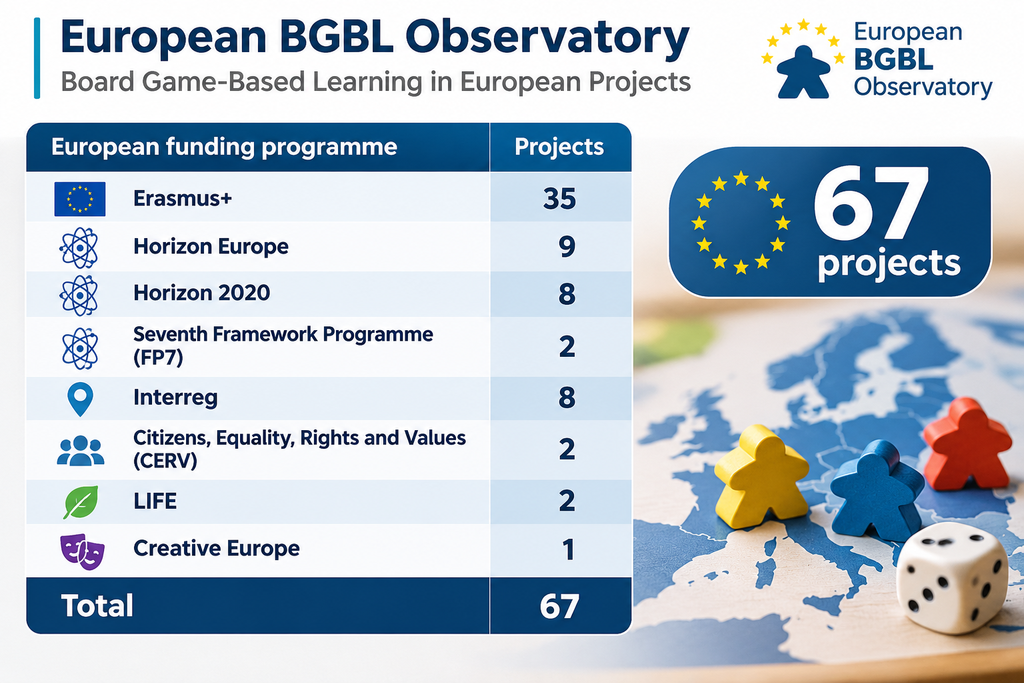
Erasmus+ accounts for 35 projects, reflecting the relevance of educational games in school education, adult learning, vocational education and youth work. However, the collection also includes 19 projects funded through successive European research framework programmes (FP7, Horizon 2020 and Horizon Europe). This is particularly noteworthy because, in many cases, board games were developed as educational, training, research communication or stakeholder engagement tools within broader scientific initiatives.
The inclusion of projects funded through Interreg, LIFE, CERV and Creative Europe further demonstrates the methodological diversity of the field, extending into environmental conservation, democratic participation, cultural heritage, public engagement and territorial cooperation. These figures describe the Observatory’s initial collection and should not be interpreted as representative estimates of all European projects using educational board games.
How are board games being used?
One of the Observatory’s central objectives is to distinguish between different approaches to Board Game-Based Learning. Rather than treating all initiatives as equivalent, projects are classified according to the role that board and tabletop games play in their educational methodologies.
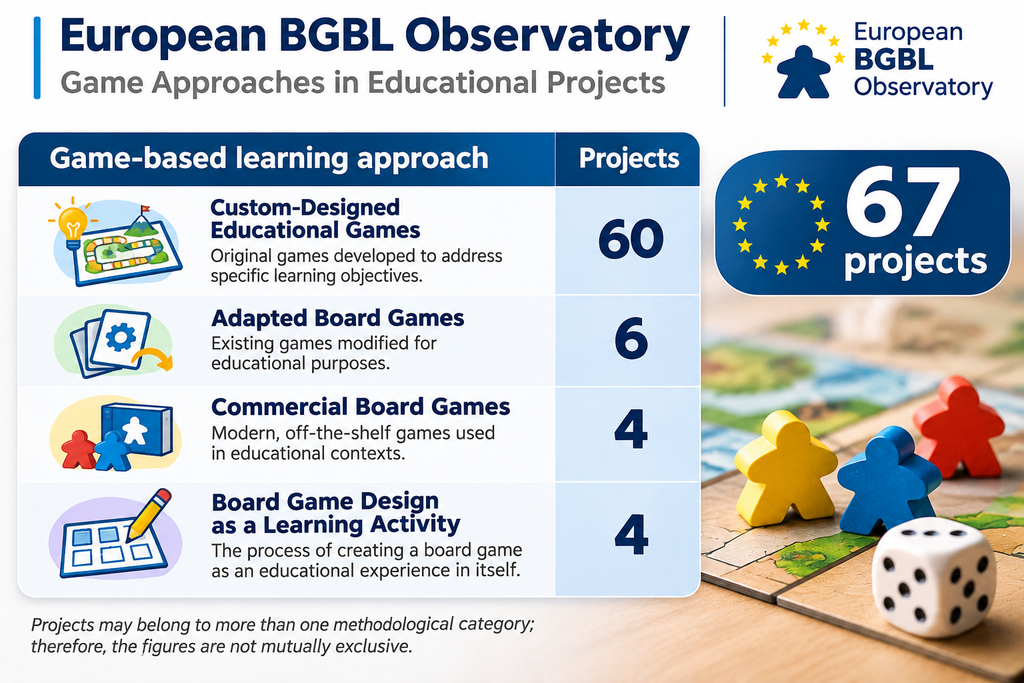
The most frequent approach involves the development of original educational games designed to address specific learning objectives. Examples range from simulations of democratic decision-making and environmental challenges to activities supporting digital literacy, professional competences and social inclusion. Other initiatives adapt existing board games or familiar mechanics to new educational purposes. Some employ modern commercial games as learning experiences, supported by pedagogical guidance and reflection activities.
A further approach considers the process of designing a board game as an educational activity in itself. In these projects, participants develop prototypes, negotiate rules, test mechanics and refine their designs, creating opportunities to practise creativity, communication, collaboration and problem-solving. These approaches can coexist within the same project. The Observatory therefore classifies them as methodological characteristics rather than mutually exclusive project types.
What educational areas does the Observatory cover?
The projects address a broad range of learning objectives and target groups, from primary school pupils to older adults, including youth workers, teachers, professionals, families and community organisations.
The most frequently represented learning area is Transversal Skills, assigned to 49 projects, followed by Sustainability & Environment (29), STEM & Digital Literacy (20), Democracy & Citizenship (18), Inclusion & Diversity (13), Employability & Entrepreneurship (11), Health & Wellbeing (7), and History & Cultural Heritage (5). As with methodological approaches, projects may address multiple learning areas.
This diversity highlights the adaptability of tabletop gaming to different educational contexts. Nevertheless, the Observatory does not assume that using a board game automatically produces meaningful learning outcomes. The relationship between game mechanics, educational objectives and available evaluation evidence remains central to each analysis.
How are projects selected?
The European BGBL Observatory is a curated collection, not an exhaustive database of European game-based learning initiatives.
Projects are assessed against explicit editorial criteria:
- Verifiable project identity. The initiative must be identifiable through reliable European or national project documentation.
- Identifiable physical game. The project must involve a board game, card game or other physical tabletop format. Hybrid physical–digital approaches are eligible when the tabletop component has a meaningful educational role. Exclusively digital games are excluded.
- Educational relevance. The game must be associated with identifiable learning, training, awareness-raising or developmental objectives.
- Supporting documentation. Sufficient information must be available to establish the nature of the game and its relationship with the project’s educational activities.
- Resource accessibility. The availability of project websites, educational materials, rules and supporting resources is considered, with limitations documented where appropriate.
The selection process draws on official project repositories, including the Erasmus+ Project Results Platform, CORDIS, the EU Funding & Tenders Portal and KEEP.eu, together with official project websites, institutional publications, methodological documents, educational resources and scientific literature.
Information is checked against the available sources, and projects are assessed individually before inclusion.
Beyond project descriptions: a methodological assessment
A distinguishing feature of the Observatory is that each project record goes beyond summarising its objectives and activities. Individual entries examine the games used or developed, their learning objectives, target groups, educational methodology, implementation, evaluation and available resources. They also provide references to the supporting documentation.
Each entry concludes with a Ludus Magnus Methodological Insight, offering a critical interpretation of the project’s contribution to Board Game-Based Learning. This assessment considers methodological strengths, opportunities for educational transfer, resource availability and limitations in the published evidence.
Particular attention is paid to distinguishing three different levels of documentation:
- Game development: evidence that a game or prototype was created.
- Educational implementation: evidence that the game was used in an educational, training or engagement activity.
- Learning outcomes: evidence that educational effects were assessed and supported by an appropriate evaluation.
These distinctions are essential. A project may have developed an innovative and engaging game without demonstrating measurable learning improvements. Similarly, a game may have been successfully implemented without its complete materials being publicly available for replication.
The Observatory explicitly acknowledges such limitations rather than interpreting project descriptions or positive participant feedback as proof of educational effectiveness.
A practical resource for educators, researchers and European organisations
The Observatory has been designed to support different forms of educational and professional activity.
For teachers and trainers, it provides examples of how board games can be integrated into learning environments, together with methodological resources and, where available, downloadable materials.
For researchers, it offers a structured starting point for identifying relevant projects, examining methodological approaches, exploring available evidence and detecting gaps requiring further investigation.
For organisations developing European projects, the platform can help identify existing educational solutions, explore possibilities for adaptation, avoid unnecessary duplication and discover potential opportunities for cooperation.
For game designers and educational developers, the collection provides examples of how tabletop mechanics have been connected to learning objectives, including both promising practices and documented methodological limitations.
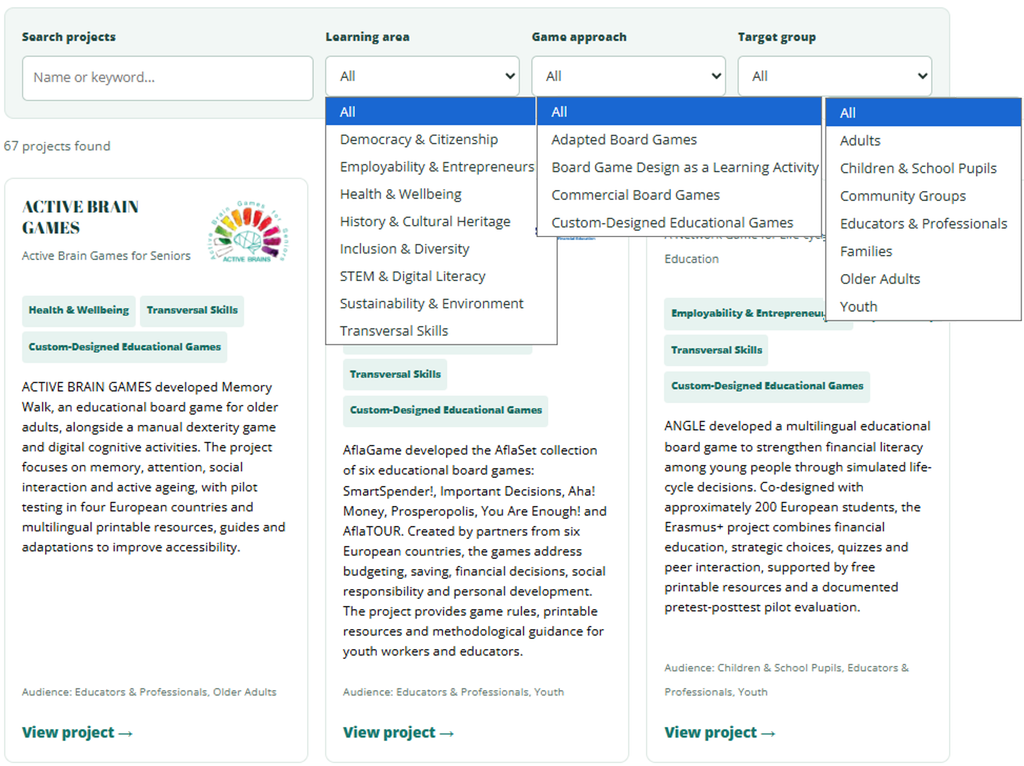
Users can search the collection by project name or keyword and filter the results according to three complementary dimensions: learning area, game approach and target group. These tools make it possible, for example, to identify projects using commercial board games to develop transversal skills, explore original games focused on environmental education or locate educational resources designed for particular audiences.
An evolving resource for European Board Game-Based Learning
The publication of the initial 67 projects marks the launch of the Observatory, but not the completion of its development. Ludus Magnus intends to maintain and expand the collection as additional initiatives are identified, new educational resources become available and further evidence emerges.
The Observatory also welcomes information about relevant projects that may not yet be included. Researchers, educational institutions, project coordinators and other organisations are invited to suggest initiatives supported by verifiable project documentation and identifiable tabletop learning resources.
The wider objective is to contribute to a more accessible, transparent and evidence-informed understanding of how board and tabletop games are being developed and used in European educational initiatives.
By connecting project information, educational resources and critical methodological analysis, the European BGBL Observatory seeks to support not only the dissemination of existing experiences, but also the development of more rigorous, transferable and effective Board Game-Based Learning practices.
Data snapshot: 18 November 2026. Statistics refer to the 67 published project records. Funding programmes are counted once per project; learning areas and methodological approaches may overlap. The collection is curated and is not a systematic census of all European-funded educational gaming initiatives.